Gamelins’s Guns Give Germany a Desperate Problem on West Front
By A. G. MACDONELL
A. G. Macdonell, author of “Napoleon and his Marshals” and other best-sellers, is a novelist and historian of distinction, as well as an authority on military tactics.
In his weekly articles in “The War Weekly,” you will be able to follow the thrill that lies behind the brief communiques that are issued to the Press.
.
“The whole of the Western Front sprang to life to-day, and under cover of a ‘box barrage’ by their artillery - used for the first time - German troops attempted a big raid east of the Moselle, near Luxembourg. After a heavy bombardment the German artillery put down their barrage - three lines of fire, of which one was at the rear, to prevent men in the attacking positions from retreating.”
And so the old, grim, familiar story begins once again. For those who have been through it once, every word conjures up a scene out of those old days. And for those who have no first-hand experience of warfare, it is the business of the writer to try to present some sort of an idea of what is happening, and what is likely to happen. It will be the task of THE WAR WEEKLY to explain, as clearly as possible, exactly what these dry, official communiques mean, and what our friends, our relations, and all the soldiers of the new B.E.F. are going through.
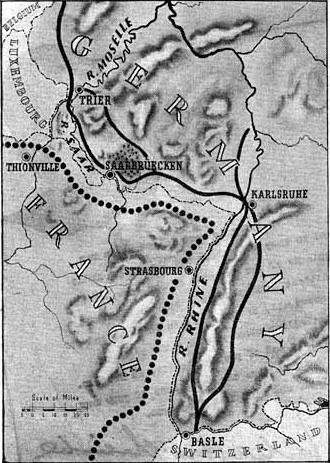
Map showing relative positions of the Maginot and Siegfried Lines. It will be observed that in places the latter is a double line, while the French fortification is a single line throughout.
New Technique
THE war on land, as we in this country will know it, is, of course, on the Western Front. But before I come down to a consideration of the Western Front I must briefly describe the lightning war in which Germany destroyed the Polish Army.
In an unparalleled exhibition of speed and organisation, the Germans succeeded in eliminating an army of more than a million men in less than a month. To understand and appreciate exactly what happened, you must bear with me for a moment while I explain one of the fundamental elements of military science.
Fixed Pivot
NAPOLEON laid down the principle that no army should attempt to manoeuvre unless it has a fixed pivot on which to base itself. There must, in effect, be one solid advantage to hold on to while your wings are doing their manoeuvring.
This solid advantage may be a town, an impregnable field-entrenchment, or an outstanding hill which can be easily defended, or the last line of an unfordable river.
Thus, in 1914 the German Army did its great manoeuvre through Belgium on the solid pivot of the German defences from Switzerland to Verdun. They knew that this was their secure bastion, and so they could afford to take risks in the big sweep round the northern edge of it.
Reckless
NOW apply this to the German strategy in Poland. It looks at first sight as if they threw the principle of the pivot to the winds. Their mechanised columns drove forward at a reckless speed, leaving their communications open to the enemy, and apparently operating completely detached from each other.
Actually, however, this was not the case. The apparently reckless speed of the advance was all coordinated round a brand new sort of pivot, which was the German Air Force.
It was this central block of fighting power that kept the motorised columns alive.
The German Air Force protected the communications, co-ordinated the movements of the columns, and provided a perpetual mobile barrage of bombs, corresponding to the artillery barrage of ordinary trench warfare.
It will be seen, therefore, that the German lightning war in Poland was a brilliant example of using the eternal principles of war and bringing them up to date with the latest and most efficient of weapons. This combination of extreme mobility, plus the tremendous firepower of the bomb and the tank-gun, ruined the old-fashioned Polish Army in a few days. It could only succeed against an old-fashioned army. If for one moment the control of the air had been lost, the motorised columns would have been lost too, and the lightning war would not have existed.
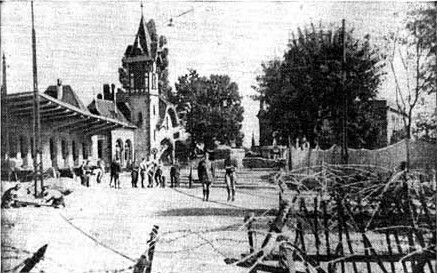
Barbed wire barricade erected by French troops across the main street of a newly-captured German village. The buildings, bearing no shell or bomb scars, contrast graphically with those of Polish villages taken by the German invaders.
In Five Sections
LET us now turn to the Western Front to-day. And here we must take the broad view and examine the Western Front from the Mediterranean at Nice to the mouths of the Rhine in the North Sea.
Strategically, this line of about six hundred and fifty miles falls into five distinct sectors. There is, firstly, reckoning from the south, the Franco-Italian frontier from Nice to the high hills of Savoy and the frontier of Switzerland. Secondly, there is Switzerland itself. Thirdly, there is the Rhine frontier between France and Germany, which runs from Basle in Switzerland and the neighbourhood of Karlsruhe. Fourthly, there is the abrupt turn which the Franc-German frontier takes, left handed, between the Rhine and the Moselle, And lastly, there are the three neutral countries between the Moselle and the North Sea - the Grand Duchy of Luxembourg, Belgium and Holland.
We need not trouble ourselves with the first sector - between Nice and Switzerland. That is the neutral frontier between France and Italy. Nor in this article do I intend to discuss sectors two and five. There is a possibility that Switzerland and the three northern neutrals may be involved before this second great war is over, but that possibility lies in the future, and I am at the moment only discussing the present.
Quite Different
THE two sectors which are of immediate importance are the third and fourth. These two sectors, which constitute the whole of the Franco-German common frontier, are utterly different from each other in character.
The first, from Basle to the right-angle turn near Karlsruhe, is completely dominated by the fact that the frontier is the great, broad, magnificent Rhine. On each side of the river, and quite close to the banks, run the two great lines of fortification - Maginot and Siegfried. Concrete faces compete at comparatively close quarters, and vast, hidden guns, capable of throwing shells a dozen miles, are within a few thousand yards of each other.
An offensive by either side on this front is unthinkable. One of the most dangerous operations in military science is, and always has been, the crossing of a river in the face of an undefeated enemy. It makes no difference what weapons armies may be using: the principle is eternal. To cross a river under fire from catapults, slings, bows and arrows, arquebuses, mediaeval culverins, smooth-bore, slow firing artillery, or the modern quick-firing field-guns and giant howitzers and aeroplane bombs - it is all the same.
There are one or two cases in history in which it has been brought off without disaster, notably in 1809 when Napoleon crossed the Danube at Vienna in order to attack the Archduke Charles.
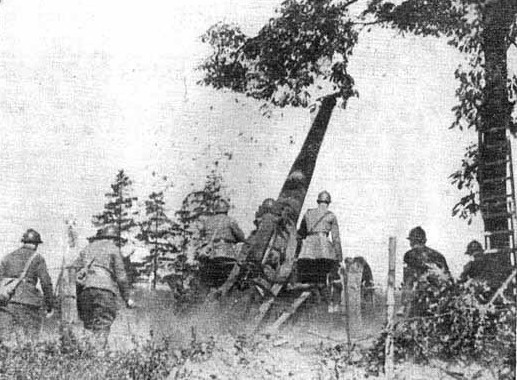
Heavy French gun, partly hidden by tree foliage, helps to clear the way for a further advance into Germany by infantry and tanks. Putting up a barrage of high explosive shells it is smashing down barbed wire entanglements and other obstructions.
Both sides of the Frontier
WE can thus rule out the lines from Basle to the Karlsruhe angle. There will be no fighting there except cannonades. That brings brings us to the hundred miles stretch which runs from the little town of Lauterbourg in that angle to the frontier of Luxemburg.
It is on this front that all the activity so far has taken place.
Let us quickly summarise the position geographically. (I am not talking now about the fortification, but simply about the country.( First there are the Wissembourg Lines of easy, low-lying country through which an eighteenth century army could march. To-day a dozen miles would be a hopelessly narrow front for the deployment of a modern army, as was found to our cost at Cambrai in 1917.
Then came the mountains, impregnable by nature on both sides. Then between the mountains and Saarbrucken a flat country, much broken by woods, and continuing north-west of Saarbrucken as far as the Hochwald. Then west of the Hochwald the long, flat corridor between the Saar and the Moselle, leading in the direction of Trier.
So much for Nature. Now what about art? - by which I mean the art of fortification. The Maginot Line leaves the Rhine about fifteen miles south of the Lauterbourg salient, and cuts north-westwards through the woods in the direction of Wissembourg, and thence due west through the forested slopes of the northern Vosges (or southern Hartz, whichever you like to call them), and turns northwest again to cover the fortress of Thionville.
At seom places it is as far as ten or twelve miles on the french side of the frontier.
The Siegfried Line, or West Wall as the Germans officially call it, hugs the frontier much more closely until it reaches the neighbourhood of Saarbrucken.
Prestige Thrust
THERE it divides into two, the rear or main line cuts across more or less directly from Saarbrucken to trier, while the forward, or subsidiary loop follows the line of the Saar River up to the Luxembourg frontier about five miles west of Trier.
You will see, therefore, that the only parts of the Rhine-Moselle front which are not defended either by nature or by the art of fortification on the German side are the two salients immediately on each side of the Saarbrucken, and the long, thin corridor between the Saar and the Moselle in the direction of Trier, and it is these three points that ninety per cent of the fighting so far has taken place.
Let us now turn to the progress of operations on the Western Front from the outbreak of war up to to-day. Many people, myself included, thought that the Germans might show an offensive spirit on the West, if only for the sake of prestige.
Germany’s Boast
IT was one of the loudest boasts of the German High Command in the last war that no fighting took place on German soil after the great battle of Tannenberg in 1914, when the Russians were thrown out of East Prussia. It was to be expected, therefore, that Hitler’s prestige would demand that no foreign soldiers should march on to sacred German soil. This expectation was wrong. The Germans on the West have so far maintained a completely negative defensive attitude.
The French on the other hand, almost immediately began to explore the German territory between the frontier and the Siegfried Line. This territory is, roughly speaking, a long strip anything from two to five miles wide, much of it wooded, much of it dotted with villages, and only a small part comparatively open.
Fight for Hill
ON September 6 the 5th official French communique announced that a few local advances had been made. On the 7th the Germans began to evacuate civilians from Saarbrucken, the great mining town which is the capital of the Saar Basin.
Next day there were “local advances.” I will discuss the meaning of “local advances” on another occasion. On September 11 the French pushed forward on a twelve-mile front east of the river Saar. That is to say, threatening the eastern side of Saarbrucken. And on the following day the Germans made a small counter-attack to recover a hill which threatened their outposts.
The counter-attack failed, and during the next week the French pushed very slowly, but very steadily, eastwards and northwards on each side of Saarbrucken. On September 15 the French extended their nibbling, and began to move northwards parallel to the Luxembourg frontier on the edge of the corridor between the Saar and the Moselle.
Sunday, September 17, saw the beginning of a new development. Reconnaissance flights by the R.A.F. and the French Air Force reported that troops were beginning to arrive on the West from Poland. This, of course, meant a general stiffening of the “West Wall.”
But the French continued to creep forward, yard by yard. In particular, they had to be very cautious in moving through the Warndt Forest, which is on the west of Saarbrucken. This forest stretches southwards into France in a square, hammer-headed salient, and was obviously undefendable by the Germans from the very start.
Deadly Booby-Traps
NEVERTHELESS, with their indefatigable ingenuity the Germans had filled the forest with mines and all manner of booby-traps. Veterans of the first world war will know what I mean by booby-traps, if they took part in the advance in the early days of 1917 through the country which the Germans evacuated. All those villages which lay between the line of Stalemate of December 1916 and the Hindenburg Line were evacuated and left full of mines and traps.
So it was in the Warndt Forest, it was impossible to trust anything. A fountain pen lying on the floor of a house might contain a detonator. A tempting bottle of champagne might, the moment the cork was touched, blow up a house. Mines could be laid under a road with a time-fuse so that they would not blow up until perhaps days had passed. No one has ever denied the engineering skill of the Germans, and no one has ever denied their diabolical ingenuity. So no wonder the French went very carefully through the forest.
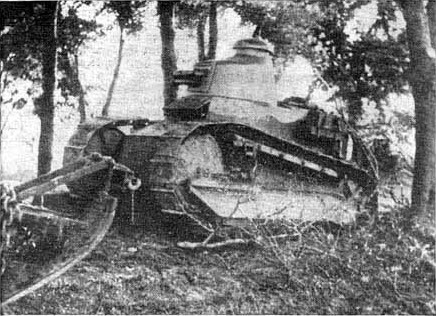
A French tank rests under the cover afforded by a clump of trees, while awaiting the order for another attack on the enemy. The wicked-looking muzzles of a three-barrelled multiple gun project from its turret.
What the Enemy Lost
IN the meanwhile the Supreme War Council had met for the second time, on the French side M. Daladier and General Gamelin, and on the British side Mr. Chamberlain and Admiral-of-the-Fleet Lord Chatfield. It is worth while remembering that it was not until the dark days of 1918 that the famous conference took place at Doullens at which Lord Milner played the decisive part in the appointment of Marshal Foch as the supreme commander of the Western Front.
Just consider those dates for a moment. It took three years and a half in the first great war to establish complete co-ordination between the British and the French Armies. In the second great war it has taken less than ten days.
What They Lost
ABOUT the middle of the third week of September the German artillery came into action in a marked manner, and even started firing across the Rhine on the Basle-Lauterbourg sector. What they they hoped to gain from this is a matter of conjecture. What they lost, of course, was a number of valuable shells without doing the slightest harm to the French garrison of the Maginot Line.
On September 22 there was a lull in the artillery fire, and the French continued to send out patrols and to consolidate the ground in Germany which they had captured in the course of the previous three weeks. And on the next day there was skirmishing near Wissembourg, and German counter-attacks, which were not successful. It is only right, however, to add that they do not seem to have been pressed home with any great vigour. On both sides operations were marked with a tentative sort of appearance.
Look how much the French have taken of Germany
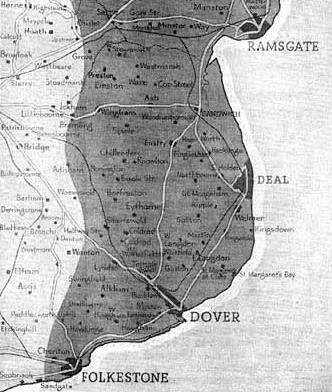
FEW realise how much land General Gamelin has nibbled away from the Germans. In this map of Kent the shaded portion will indicate to you just how much it is. The steady daily thrust, capture and strengthening of positions that has gone on for more than six weeks has actually resulted in a great gain of territory, all of which has been fortified. It is far more important than you will realise from this map, which shows merely the happy holiday coast, whereas General Gamelin has driven the Germans from a vast industrial region, which is the very life blood of her armament supplies. Desperate counter-attacks have been made by the Germans to recover this.
Tanks Lead the Advance
AS soon as the counter-attacks had died away, the French crept forward again. On September 30 Paris announced an advance along corridor between the Saar and the Moselle of over two thousand yards. Tanks led the attack. And all the while a steady nibbling was going on at the sector on each side of Saarbrucken.
As a result of the first six weeks of the war we see the French established along a good many miles of the front indide German territory. They have not yet come up against the actual Siegfried Line itself or the Siegfried loop which runs from the back of Saarbrucken to the neighbourhood of Trier, nor have they launched a large-scale attack at any point. What they are doing is this. They are extending the defensive depth of the Maginot Line rather than threatening the German “West Wall.”
These continuous advances are actually for the purpose of defence. If and when the Germans launch a full-dress offensive between the Rhine and the Moselle, they will first of all have to dislodge the French out of this new fortified zone between the two lines, and it will be a costly business. As the experience of the last war proved, it is often more difficult to attack an improvised defence line than a solid, carefully prepared line.
Every Inch Known
THE solid line is well known; it has been photographed a hundred times from the air, every inch of it is known to the attacking artillery, and the preliminary bombardment can be accurate and devestating. But an improvised line, especially if it is heavily manned with machine guns, and especially if it runs through wooded or industrial country, can be extraordinarily difficult to tackle.
I have no doubt whatever that a tremendous motorised attack by the Germans would drive the French back from these advanced entrenchments, but only at great cost. And there is another point to consider. Let us assume that the Germans have succeeded in pushing the French back out of Germany on to the Maginot Line. They will then have to organise the attack upon that line, and they will have to do it across country that has already been heavily smashed by artillery fire.
Shell-Fire
THAT is to say, they will have to cross a battlefield before they get to the main batlefield. And anyone who remembers what shell-fire can do to a countryside will realise the difficulties which the Germans will have to face in fetching up their tanks to attack the French main lines.
There is also another possibility which must be considered, and it is this. The French High Command may well say in the course of the next few days that these advanced entrenchments have already served their purpose, especially now that winter is coming on. It may decide that it would be more economical in the long run to withdraw back into France, leaving behind, perhaps, a row of harassing rear-guard posts, and to ensconce themselves comfortably in the Maginot Line.
If, therefore, you read in the course of the next week or so that the French are pulling in their outposts you must not jump to the conclusion that they are falling back under pressure. They will be fallinjg back in order to conserve their energies and give their infantry a pleasanter life in the permanent fortifications when the rains begin than out in the No Man’s Land
Reading Between the Lines
ON Wednesday, October 11, Mr. Hore-Belisha, Secretary of State for War, made some dramatic announcements in the House of Commons. The new B.E.F. he said, consists of a hundred and fifty-eight thousand men, all of whom, without one single exception, have arrived at their concentration points in France without a casualty.
In 1914 more than half of the first B.E.F. consisted of infantry men, with two machine-guns to a battalion. Now the infantry make only one fifth of the total, and each battalion has fifty Bren guns and sixteen anti-tank rifles. In 1914 there were eight hundred motor vehicles. Now there are twenty-five thousand. (And it is one of the advantages of re-arming at the last possible moment, that the technical equipment must obviously be the latest and most up to date in the world.)
It is possible, reading between the lines of Mr. Hore-Belisha’s statement, to get some idea of the whereabouts of the new B.E.F. When the Minister himself tells us that ‘the sons are treading again upon soil made sacred by the fathers,” it is giving away no secret to assume that our modern Army is taking post on the left of the French, covering the frontier of Belgium.
The soil in France made sacred by the British Army of earlier days stretches from St. Omer as far south as Amiens, with a small isolated pocket at Soissons, in 1918, and a sector of the Chemin des Dames in the same year. So it is safe to conclude that the new B.E.F. is somewhere in the neighbourhood of the Vimy Ridge, and Hazebrouck, and Cambrai, and Le Cateau.
Choice of Four Plans
THIS, then, is a summary of what has been happening on the Rhine-Moselle front during the first six weeks of the war. Next week I propose to examine Germany’s possible plans of campaign. The German High Command has, I think, the choice of four plans, and it must make up its mind very quickly which of them to adopt.
The autumn does not last forever, and winter is not the best time for the deployment of mechanised forces. Ask any old soldier what he thinks about mud, and don’t blame me if you get a surprisingly picturesque reply.
Next week - Another thrilling article by A. G. Macdonell on the progress of the War on the Western Front. Make sure of your copy.